



Insights ·
What Business Information Should You Never Share with External AI Tools?
The information that makes AI most valuable to your business may also be the information you most need to protect.
By Margins team · 14 min read
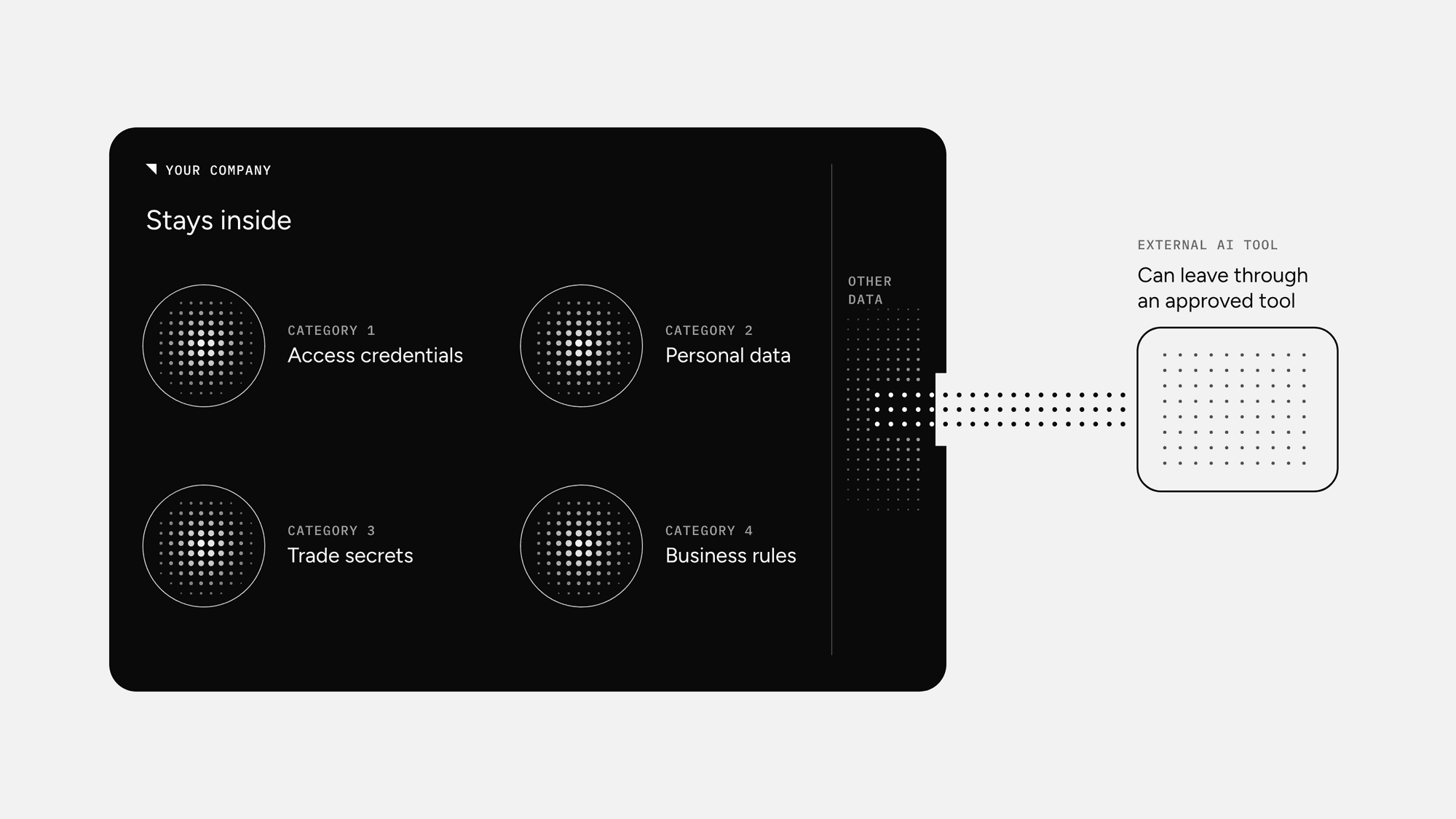
Imagine a sales manager uploading several years of customer transactions into an AI tool to identify purchasing patterns. Or a procurement specialist asking an AI assistant to analyse supplier agreements and recommend better negotiation strategies.
Both are perfectly reasonable uses of AI. They could save hours of work and uncover valuable insights. But those same documents might reveal customer relationships, pricing strategies, supplier discounts, purchasing behaviour and internal decision-making rules that the company has developed over many years.
None of this information necessarily looks like a traditional security risk. There may be no passwords, personal identification numbers or documents explicitly marked confidential.
Yet collectively, it could reveal a great deal about how the company operates and what makes it competitive.
This creates an important challenge for businesses adopting AI: the more AI understands about your company, the more useful it can become. But how do you give AI access to that knowledge without unnecessarily giving up control over it?
The answer isn't to avoid AI or prohibit employees from using it. It's to understand what information is being shared, how different AI services process that information, and which safeguards are appropriate for each use case.
1. The obvious risks: credentials, personal data and confidential information
Some information should never be entered into an unapproved AI service.
Passwords, API keys, authentication tokens, private encryption keys and other access credentials are clear examples. They can provide direct access to company systems, databases and cloud infrastructure.
Even when an employee shares a credential simply to troubleshoot a technical issue, it may be processed or retained by the service. Real credentials should be replaced with placeholders, and any potentially exposed credentials should be assessed and rotated or revoked where necessary.
Personal data is another important category.
Customer records, employee information, financial details, health information and other personal data cannot simply be uploaded into any AI service an employee finds convenient.
Under the EU General Data Protection Regulation (GDPR), organisations must have an appropriate legal basis for processing personal data and ensure that the processing meets applicable data protection requirements.
This doesn't mean personal data can never be processed using an external AI provider. It means the organisation must establish whether the processing is permitted and ensure appropriate technical, organisational and contractual safeguards are in place.
Removing names or email addresses isn't necessarily sufficient. A combination of job titles, transaction histories, locations or other details may still make an individual identifiable.
Companies must also consider information belonging to customers, suppliers and business partners. Confidentiality obligations may apply even when the information contains no personal data.
These are relatively familiar information security and compliance concerns.
But there is another category of business information that deserves just as much attention.
2. Your company's proprietary knowledge may be more valuable than you realise
Consider what differentiates two companies operating in the same industry.
Both may use similar software, employ people with comparable qualifications and have access to the same AI models. Yet one consistently achieves better margins, manages inventory more effectively, serves customers faster or makes more accurate commercial decisions.
Often, the difference comes from knowledge accumulated through years of operating the business.
That knowledge may include:
- How the company determines prices and discounts for different customers.
- Which supplier terms it has negotiated and how it evaluates purchasing decisions.
- How employees recognise early signs of customer dissatisfaction or declining demand.
- Which exceptions require special treatment in an otherwise standard process.
- How the company forecasts demand, allocates resources or manages operational risks.
- Which internal rules and decision criteria have proven effective through experience.
Some of this information is formally documented. Some exists in spreadsheets, business applications, emails and internal procedures. Other parts reside in the experience of employees who have learned how to handle situations that don't fit standard rules.
Much of this knowledge may not be formally classified as confidential. Nevertheless, it can be a significant source of competitive advantage.
Under the EU Trade Secrets Directive, certain information may qualify as a trade secret if it is not generally known or readily accessible, has commercial value because it is secret, and has been subject to reasonable steps to keep it secret.
However, the legal definition of a trade secret is not the only relevant consideration.
Information can be strategically valuable even when it doesn't meet the formal definition of a trade secret.
A company's pricing methodology, operational procedures or accumulated expertise may be worth protecting simply because competitors could benefit from understanding them.
This becomes particularly important when employees begin using AI to analyse internal business information.
The risk isn't always in a single document
Imagine a company uploading its monthly sales reports into an AI assistant.
One report might reveal relatively little. But several years of reports, combined with customer segmentation, discount structures and purchasing histories, could provide a much more detailed picture. Together, they might reveal which customers are most profitable, how demand changes throughout the year, which products are strategically important and how the company responds to changes in purchasing behaviour.
The same principle applies to procurement records, manufacturing data, logistics processes, internal financial projections and technical documentation.
Individually, these documents may appear ordinary. Collectively, they can reveal valuable operational and commercial knowledge.
This doesn't mean that uploading them to an external AI service automatically makes the information available to competitors. It means the company needs to understand what happens to the information once it leaves its controlled environment.
3. What actually happens when you share information with an AI service?
One of the most common misconceptions about AI is that every piece of information submitted to an external model automatically becomes part of its training data.
That isn't how every AI service operates.
Different providers, products and subscription plans have different approaches to data processing, retention, security and model training. For example, an enterprise AI service may contractually exclude customer data from model training, while a consumer service may have different default settings or terms.
However, not using data for model training doesn't necessarily mean that the data is never stored, logged or processed outside the organisation.
Companies should distinguish between several questions.
Is the information used to train or improve models?
Some services may use submitted content to improve their models or products, depending on the service, contractual terms and settings.
Others explicitly exclude customer content from model training.
Companies should verify the policy applicable to the specific product and account they are using rather than relying on general statements about a provider.
How long is the information retained?
Even when submitted content is excluded from model training, prompts, uploaded files and generated responses may still be retained for operational, security, abuse-monitoring or other purposes.
Retention periods and deletion options vary between services.
Who can access the information?
Depending on the service, submitted information may be accessible to authorised provider personnel or subprocessors under defined circumstances.
The relevant question is not simply whether a provider is trustworthy, but whether the access controls and contractual protections are appropriate for the information being processed.
Where is the information processed?
Data residency, international transfers and the locations of subprocessors can be important considerations, particularly for organisations subject to regulatory or contractual requirements.
What happens when AI connects to internal business systems?
AI is increasingly used through integrations with document repositories, CRM platforms, ERP systems and other enterprise applications. These integrations can provide considerable value, but they introduce additional considerations.
An AI assistant connected to a company's document management system may have access to far more information than an employee manually enters into a prompt. Organisations need to consider which systems the AI can access, whose permissions it uses, which information can be retrieved and what data is transmitted to external services.
The important distinction is between giving AI access to information and giving it unrestricted access to everything.
A well-designed AI implementation should provide the information necessary to complete a task while maintaining appropriate controls over what can be accessed, processed and shared.
4. Four examples of everyday AI use that deserve closer attention
The risks become easier to understand when we look at how employees actually use AI.
Sales: analysing customer relationships
A sales manager uploads customer purchasing histories, account notes and negotiated prices into an AI assistant to identify opportunities for additional sales.
The business value: AI can identify purchasing trends, potential customer churn and opportunities that might otherwise be missed.
What needs protection: Customer-specific agreements, commercial relationships, pricing strategies and potentially personal data.
A better approach: Use an approved AI environment with appropriate access controls and data-processing safeguards, or connect an AI solution directly to authorised CRM data through a controlled integration.
Finance: reviewing internal performance
A finance director uploads detailed management reports and financial forecasts to understand which business units are underperforming.
The business value: Faster analysis, identification of unusual trends and support for financial planning.
What needs protection: Non-public financial information, operating margins, forecasts and strategic investment plans.
A better approach: Use an approved enterprise AI service or an internally controlled solution that meets the organisation's confidentiality and security requirements.
Procurement: comparing supplier agreements
A procurement specialist asks AI to compare supplier contracts and recommend negotiation opportunities.
The business value: Faster contract analysis, better visibility into commercial terms and identification of potential savings.
What needs protection: Negotiated discounts, supplier relationships, contractual obligations and purchasing strategies.
A better approach: Use approved tools with suitable contractual protections, restrict access to relevant agreements and avoid transmitting information that isn't necessary for the analysis.
Operations: improving internal processes
An operations manager provides an AI assistant with detailed procedures, exception-handling rules and operational performance data to identify inefficiencies.
The business value: AI can help identify bottlenecks, automate repetitive decisions and improve consistency across operations.
What needs protection: Proprietary operational knowledge, internal decision criteria and accumulated process expertise.
A better approach: Build AI capabilities that can use the company's operational knowledge within an appropriately governed environment, with access limited to the information required for each task.
These examples illustrate an important point. The solution is rarely to stop using AI for these activities.
In many cases, these are precisely the applications where AI can create the greatest business value.
The objective should be to enable them safely.
5. How to decide what information can be shared with AI
Not every business document requires the same level of protection, and not every AI service presents the same level of risk.
A practical starting point is to classify business information and establish which AI environments are approved for each category.
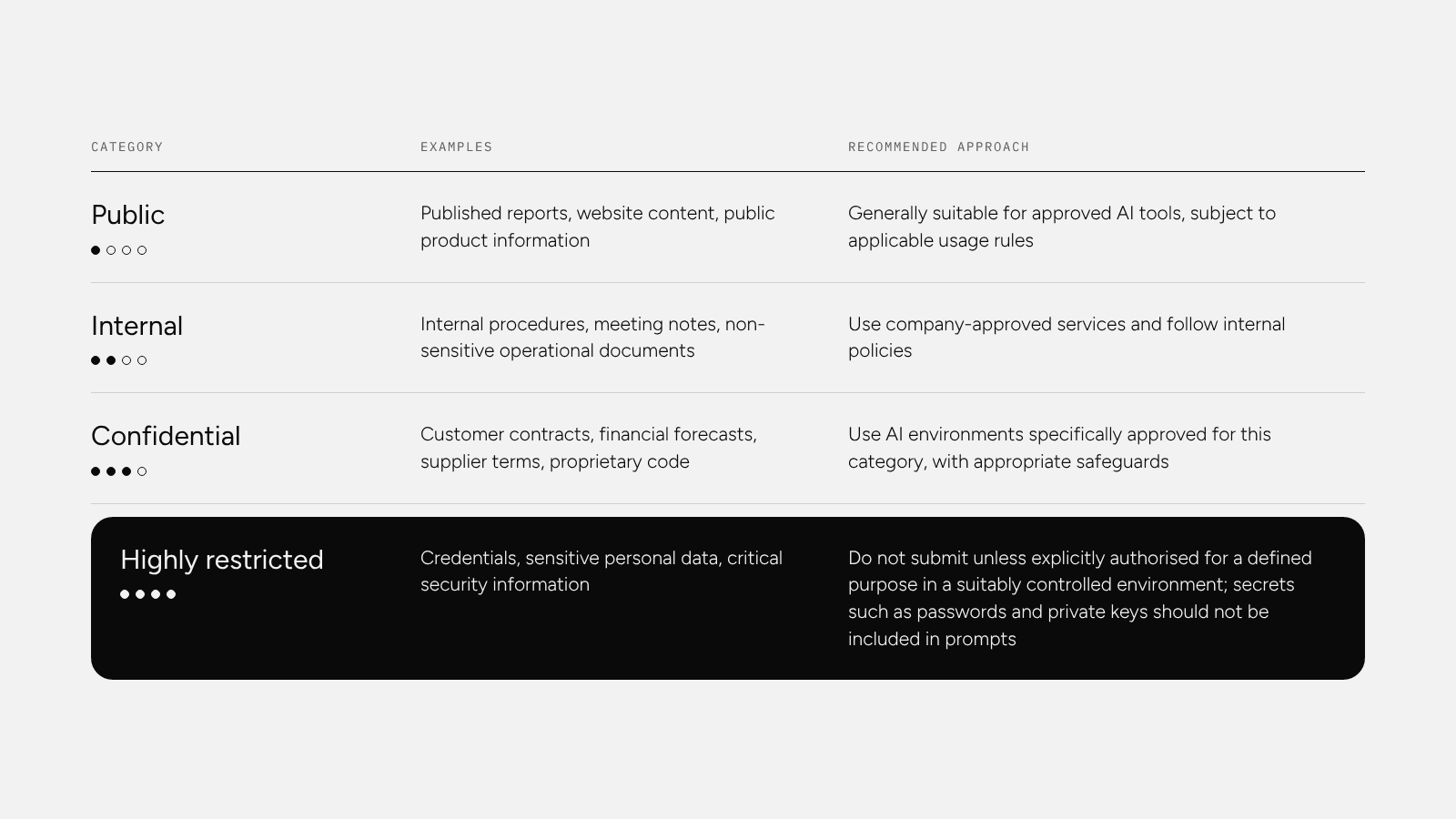
This classification should be accompanied by a few practical questions employees can answer before sharing information:
- What information am I providing? Does it contain personal data, confidential agreements, commercially sensitive details or proprietary business knowledge?
- Is all of it necessary? Could the task be completed using a smaller dataset, redacted information, synthetic examples or aggregated results?
- Which AI service am I using? Is it approved for this category of information, and what contractual and technical safeguards apply?
- Who or what can access the information? Are permissions appropriately restricted, including when AI connects to internal applications?
- What happens to the information afterwards? Understand relevant retention, processing, training and deletion arrangements.
Employees shouldn't be expected to independently interpret complex legal agreements or evaluate every AI provider's security architecture.
Those responsibilities belong to the organisation.
Employees need clear, practical guidance on which tools they can use, what information they can share and where to seek approval when a use case falls outside established rules.
6. How companies can use sensitive business knowledge without unnecessarily exposing it
For many organisations, the most valuable AI opportunities cannot be realised using public information alone.
An AI system that helps a company improve procurement decisions needs to understand its supplier relationships and purchasing processes.
An AI assistant that supports customer service may need access to customer histories, internal procedures and product documentation.
An AI system that identifies production inefficiencies needs relevant operational data and an understanding of how the production process works.
The challenge is not to keep AI away from this information. It is to design systems that can use it appropriately.
There are several approaches, depending on the sensitivity of the information and the organisation's requirements.
Approved enterprise AI services
Enterprise AI services can offer contractual commitments, administrative controls, security features and data-processing arrangements that differ from consumer products.
For many common business tasks, an appropriately configured enterprise service may provide sufficient protection.
The organisation still needs to assess the specific service, its integrations and its suitability for the intended use.
Controlled integrations with internal systems
Rather than manually uploading entire databases or collections of documents, companies can connect AI systems to approved internal data sources.
For example, an AI assistant could retrieve relevant information from an internal knowledge base or ERP system when answering a question.
A properly designed integration can enforce user permissions, restrict which information is retrieved and minimise the data transmitted for processing.
However, retrieving information from an internal system doesn't automatically mean it remains within the company's infrastructure. If an external model processes the retrieved content, that information may still be transmitted to the provider.
The architecture must account for this.
AI deployed within company-controlled infrastructure
For use cases requiring greater control, organisations may choose to deploy AI applications or models within their own cloud environments, private infrastructure or on-premises systems.
This can provide more direct control over data access, storage, network communication and system configuration.
Depending on the architecture, it may also reduce or eliminate the need to transmit sensitive information to external model providers.
But private deployment is not automatically more secure. Security still depends on implementation quality, infrastructure configuration, access controls, monitoring and ongoing governance.
The right approach isn't necessarily the one that keeps every component inside the company. It's the one that gives the organisation an appropriate level of control for the information and business processes involved.
7. Protecting business knowledge is also about competitive advantage
There is a broader strategic reason companies should think carefully about how they use AI.
Today, businesses across virtually every industry can access many of the same foundation models. Giving employees access to ChatGPT, Claude or similar tools can generate meaningful productivity improvements. But those tools are also available to competitors.
Over time, access to widely available AI capabilities becomes less of a differentiator. More sustainable competitive advantages can emerge when companies combine AI with their own data, processes, systems and accumulated operational knowledge.
Consider two distributors using the same AI model.
One uses it to draft emails, summarise reports and answer general business questions.
The other connects AI to its purchasing histories, customer relationships, inventory data and operational workflows. Its AI systems help sales representatives identify customers at risk of leaving, support purchasing decisions and recommend actions based on the company's own business rules.
Both organisations benefit from AI. But the second is developing capabilities grounded in knowledge and processes specific to its business.
Those capabilities may be harder for competitors to replicate because the underlying knowledge, integrations and operational experience are not equally available to everyone.
This is why protecting proprietary business information should not be viewed solely as a compliance exercise.
The same knowledge companies need to protect is often the knowledge they should be using to build their most valuable AI capabilities.
An effective AI strategy must address both objectives. It should make the organisation's knowledge more useful while maintaining appropriate control over how that knowledge is accessed and processed.
8. What business leaders should do next
Companies don't need to choose between adopting AI and protecting their information.
They do, however, need to move beyond a situation where employees independently decide which tools to use and what information to share. A practical starting point involves three priorities.
First, establish visibility. Understand which AI tools employees are already using, what information they process and which business activities depend on them.
Second, define clear rules and approved environments. Establish data classifications, approve suitable AI services and make it easy for employees to understand what is permitted. Ensure that employees have useful alternatives rather than relying exclusively on restrictions.

Third, identify where proprietary business knowledge can create greater value through AI. Look beyond general productivity tools and examine the processes, decisions and operational activities where company-specific knowledge could enable meaningful improvements.
This third priority is particularly important.
At Margins, we approach enterprise AI adoption as more than the introduction of new tools. We help organisations identify valuable AI opportunities, understand the processes and knowledge behind them, and design solutions that integrate with their existing systems and infrastructure. The objective is to make AI useful in the context of how each business actually operates, while applying the governance and technical controls appropriate to its requirements.
Because the long-term opportunity isn't simply to give employees access to more AI.
It's to turn the knowledge that makes your company different into AI capabilities that make it more competitive, without unnecessarily giving up control over that knowledge.
References
- European Commission — Data protection in the EU: https://commission.europa.eu/law/law-topic/data-protection/data-protection-eu_en
- Regulation (EU) 2016/679 — General Data Protection Regulation: https://eur-lex.europa.eu/eli/reg/2016/679/oj
- Directive (EU) 2016/943 — Protection of trade secrets: https://eur-lex.europa.eu/eli/dir/2016/943/oj
- European Data Protection Board — Guidelines and recommendations: https://www.edpb.europa.eu/our-work-tools/general-guidance/guidelines-recommendations-best-practices_en