


See what’s changing in your business before it shows up in the numbers.
Customer behaviour changes. Demand moves. Products underperform. Sales opportunities appear. Operational exceptions accumulate.
Margins builds AI into Food & Beverage operations to detect those signals earlier, turn them into decisions and put intelligence directly into the workflows where people can act on it.
From demand signals to commercial action.
Small changes become expensive at scale.
Individually, these changes can look insignificant. Across thousands of products, customers, transactions and decisions, they become material.
- 01One customer orders less.
- 02One category starts declining.
- 03One SKU begins moving differently.
- 04One promotion performs differently than expected.
- 05One location changes its purchasing pattern.
- 06One product sits too long.
- 07One salesperson misses an opportunity.
- 08One forecast is slightly wrong.
AI is valuable when it can find the changes that deserve attention before they become obvious.
The problem isn’t a lack of data. It’s knowing what matters inside it.
Food & Beverage businesses generate information continuously — and most already report on much of it.
- Orders
- Invoices
- Customers
- Products
- SKUs
- Prices
- Promotions
- Inventory
- Returns
- Sales activity
- Seasonality
- Supplier activity
- Field visits
- Production information
- What’s changing?
- What’s unusual?
- What might happen next?
- Where should we look?
- What should we do about it?
Move from reporting the business to sensing the business.
Demand doesn’t change all at once.
Changes can begin with weak signals — a product moving differently in one region, a customer ordering earlier, a promotion shifting the baseline. AI can analyze patterns across products, customers, locations and time to identify changes earlier.
Anticipate expected demand across products and periods.
Identify behaviour that doesn’t match expected patterns.
Understand recurring patterns without treating every change as abnormal.
Detect emerging increases or decreases.
Give purchasing, sales and operations better information for decisions.
Better forecasts matter. Earlier understanding matters even more.
Customer loss often begins long before the customer disappears.
- A customer buys one category less frequently.
- Then another.
- Order value declines.
- The basket becomes smaller.
- Purchase intervals increase.
- Some volume moves to a competitor.
- Eventually, the decline becomes visible in revenue.
43 days earlier to act on revenue at risk.
Predictive intelligence built around four years of invoice history, combining multiple detection methods and seasonal layers to identify unusual changes in purchasing behaviour and surface prioritized commercial alerts — inside the customer’s ERP environment, without business data leaving the company.
Read the case study →The prediction isn’t the outcome. The additional 43 days to act is.
Find the opportunity inside the basket.
The same transactional data can reveal which categories a customer isn’t buying, which products go together, which accounts behave differently from similar ones, and where new demand is emerging.
Which products or categories might be relevant?
Where is the customer under-indexing?
When would we normally expect this customer to buy again?
Which customers deserve attention today?
What should the salesperson investigate?
Don’t ask the salesperson to find the signal across thousands of transactions. Bring the signal to the salesperson.
Every customer conversation should start with what changed.
Before visiting or calling a customer, AI can bring together:
The salesperson shouldn’t have to reconstruct the customer before every conversation.
- ERP
- BI
- Excel
- CRM
- Salesperson’s memory
- Customer data
- AI
- What matters now
Send intelligence into the field. Bring intelligence back from it.
Head office has transactional data. Field teams have context that often isn’t captured anywhere:
- What changed at the location?
- Which competitor is gaining visibility?
- Why isn’t a product moving?
- What did the customer say?
- Which promotion is actually working?
- What is happening on the shelf?
The field shouldn’t only consume intelligence. It should continuously create it.
Put the intelligence where the commercial decision happens.
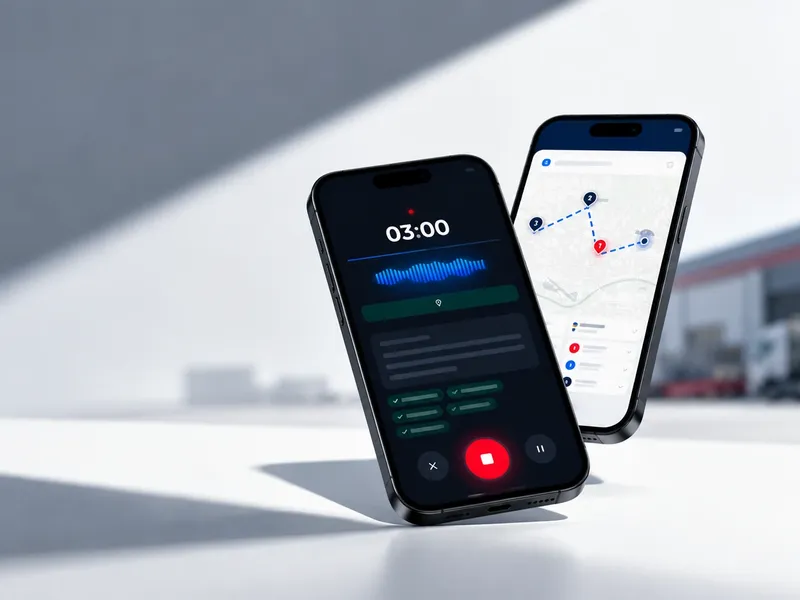
For CIAK, Margins built an AI mobile cockpit bringing together purchasing patterns, machine-learning signals, customer briefings, spoken reporting and an AI assistant for field sales — inside CIAK’s own cloud. The same pattern can apply wherever field teams manage large customer portfolios.
Relevant intelligence. At the moment somebody can act on it.
- Purchasing patterns
- ML signals
- Customer briefings
- Spoken reporting
- AI assistant
The fastest way to capture field intelligence may be speaking.
Turn what your people see and hear into information the business can use.
- Demand signalProduct A moving faster
- Order / actionAdditional delivery requested
- Competitor signalPromotion detected
- Follow-upDiscuss summer assortment
- Customer recordVisit summary stored
Some of the most valuable information isn’t stored in a system. It’s visible.
Depending on the business and use case, computer vision can help interpret images from stores, warehouses, production or field operations. Opportunity examples:
- Photo
- Detect
- Classify
- Structure
- Business signal
- Action
Turn what people can see into information systems can understand.
Too little loses sales. Too much destroys value.
Food & Beverage inventory involves shelf life, seasonality, changing demand, promotions, large SKU portfolios, supplier lead times and customer variability. AI can support decisions around:
Forecasting becomes more valuable when inventory has an expiration date.
The goal isn’t simply less inventory. It’s the right inventory at the right time.
Did the promotion create demand — or just move it?
Questions worth investigating
- 01Which promotions changed behaviour?
- 02Where was uplift strongest?
- 03What happened after the promotion ended?
- 04Did customers buy more or simply buy earlier?
- 05Did one product cannibalize another?
- 06Which customer segments responded?
- 07What happened to margin?
The important question isn’t whether sales went up. It’s why they went up and what happened next.
A lot of Food & Beverage work isn’t about food. It’s about information.
- Orders
- Invoices
- Price lists
- Supplier documents
- Product information
- Customer requests
- Emails
- Claims
- Returns
- Reports
- Approvals
- Certificates
- Specifications
- 01Email / document / request
- 02Understand
- 03Extract
- 04Validate
- 05Apply rules
- 06Update system
- 07Human exception when required
Let people handle the exceptions. Let software handle the repetition.
Some of your most valuable intelligence isn’t in your data warehouse.
- 01
A senior salesperson knows which customer reacts badly to a particular change.
- 02
A product specialist knows what substitute works when something is unavailable.
- 03
A buyer knows which supplier issues usually become serious.
- 04
A production expert knows what an unusual signal means.
- 05
A manager knows why an exception should be treated differently.
Transactional data tells AI what happened. Human expertise helps it understand what matters.
Explore CaptaThe intelligence is spread across your technology environment.
Useful Food & Beverage AI may depend on information across ERP, CRM, warehouse, ordering, inventory and production systems, BI, documents, supplier systems, customer portals and custom applications.
Your existing systems don’t need to disappear for your business to become more intelligent.
Explore IntegrationsYour data is part of your competitive advantage.
The more AI understands about the business, the more valuable it becomes — and the more important the architecture. Marikomerc’s predictive system operates inside the customer’s ERP environment without business data leaving the company.
Explore Private & On-Premise AI- Customer purchasing patterns
- Pricing
- Margins
- Recipes and formulations
- Supplier information
- Demand history
- Product information
- Commercial agreements
- Internal processes
- Organizational knowledge
The intelligence that differentiates your business should strengthen your business.
Where AI could change your business.
Hover or tap any part of the business to see the AI opportunities worth investigating there.
- Forecasting
- Exception detection
- Commercial intelligence
- Supplier intelligence
- Document automation
- Demand signals
- Supplier intelligence
- Planning support
- Back-office documents
- Order automation
- Email workflows
- Account prioritization
- Customer briefings
- AI assistants
- Revenue-risk detection
- Customer segmentation
- Cross-sell
- Next-best action
- Demand forecasting
- Stock risk
- Slow-moving inventory
- Product performance
- Basket analysis
- Assortment signals
- Voice reporting
- Image recognition
- Visit intelligence
- Connected ERP + field data
- Shared commercial context
Don’t begin with an AI transformation program. Begin with something that matters.
A customer-risk problem. A forecasting problem. A field-sales problem. An inventory problem. A repetitive process. A knowledge bottleneck.
Prove the value in one part of the business. Build from there.
- 01IdentifyWhere is value being lost?
- 02UnderstandWhat process creates the outcome?
- 03AssessWhat data and systems are available?
- 04PrioritizeIs AI the right solution?
- 05BuildPut it into the operation.
- 06MeasureDid the business outcome change?
- 07ExpandBuild the next capability.
The advantage compounds.
Imagine starting with customer-risk detection. That requires foundations — and once they exist, they support the next use case.
Foundations built by the first use caseEach useful implementation should make the next one easier.
- 01Customer risk
- 02Cross-sell
- 03Field intelligence
- 04Demand
- 05Automation
- 06Knowledge
- 07AI-enabled operations
Start inside the operation.
We work with leadership and process owners to understand where:
- Revenue is leaking.
- Demand is difficult to predict.
- Inventory decisions are difficult.
- Salespeople lack information.
- Field knowledge isn’t captured.
- Administrative work consumes time.
- Problems are discovered too late.
- Important decisions depend on individual experience.
- Systems contain valuable but disconnected information.
- 01Business problem
- 02Process
- 03Data
- 04Opportunity
- 05Value × Feasibility
- 06Implementation
The objective isn’t to put AI everywhere. It’s to find where AI changes the economics of the business.
We start with the business, not the model.
Commercial understanding
We think in terms of customers, products, transactions, behaviour and outcomes.
AI + software
We build the intelligence and the production software required to use it.
Existing systems
We integrate with the environment already running the business.
Private architecture
Sensitive commercial data can remain within appropriate customer-controlled environments.
Field + office
We connect intelligence from central systems to people operating closer to customers.
Production ownership
Our responsibility can continue through Forward Deployed Engineering and Managed AI after go-live.
Our clients in Food & Beverage.

Know which customers are at risk before the revenue disappears.
- 94.7% validated revenue losses detected
- 43-day median warning
- €3.7M annualized exposure identified
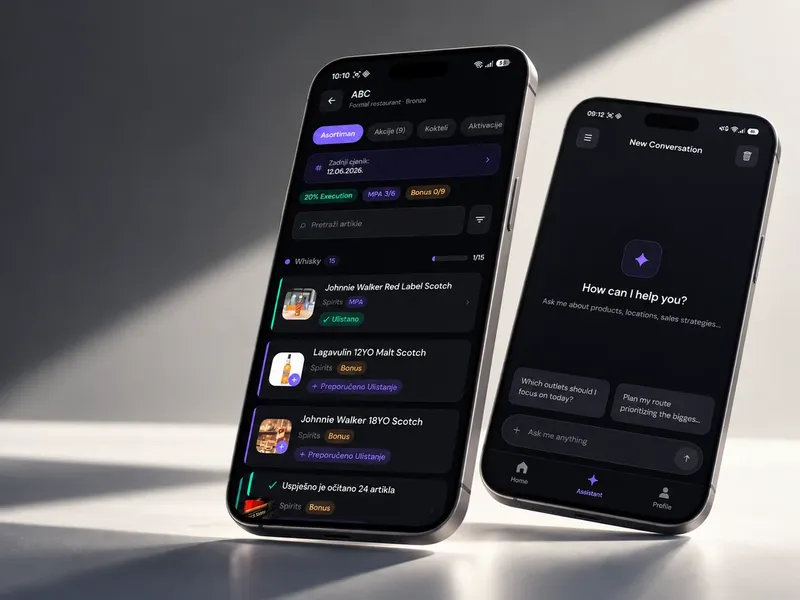
A field-sales platform for one of Serbia’s largest distributors.
- Outlet-specific strategy
- AI assistance
- Computer vision
- Management visibility
Related capabilities
AI Strategy & Consulting
Find where AI can create measurable value across the business.
Explore AI Strategy →Predictive AI
Turn historical operational data into forward-looking signals.
Explore Predictive AI →Computer Vision
Turn images and visual information into structured business intelligence.
Explore Computer Vision →Integrations
Connect AI to ERP, CRM, inventory and operational systems.
Explore Integrations →Private & On-Premise AI
Keep proprietary business intelligence under your control.
Explore Private AI →
Your business is already producing the signals. What could AI see that you can’t today?
We’ll work with your leadership and operational teams to identify where AI could materially improve revenue, sales, planning or operations — and determine which opportunity is worth building first.
Explore AI opportunitiesFind the signal. Prove the value. Build from there.