



Insights ·
AI Available to Everyone Is No One’s Competitive Advantage
The question company leadership should be asking today is not only how much AI will increase their productivity, but how much of the value it creates will they be able to keep for themselves in the long run.
By Anđelo Brzoja · 9 min read
Artificial intelligence is undoubtedly driving enormous gains in productivity across work and business. But in the race for greater efficiency, one fundamental economic principle is often overlooked: what is equally available to everyone can hardly be a competitive advantage.
In fact, the widespread availability of AI could lead to a seemingly paradoxical situation in which companies become more and more productive, yet less and less profitable.
Productivity and profit
Imagine someone gave you a magic wand today that could turn anything you touch into gold. Would you become the richest person in the world? Possibly, but only if you were the only one who had such a wand, and only if you used it thoughtfully and in moderation. If everyone were given one and started using it on a massive scale, gold would very quickly lose much of its economic value. Nothing about its physical properties would have changed. It would simply have lost the thing that makes it valuable in the first place: its scarcity.
Something similar is happening with artificial intelligence today. Companies around the world are enthusiastically discovering that, with the help of AI, they can produce in a few hours what used to take days or weeks of work: marketing campaigns, software code, business reports, visuals, analyses, even entire software applications. At first glance, it looks like an extraordinary creation of new economic value for every company. But is that really the case?
Consider a company that, until recently, had to hire a specialised agency and spend 20,000 euros to produce a marketing campaign. Today, thanks to AI, its in-house team can produce similar content in just a few hours. Management will most likely conclude that the company has saved, and created value worth, almost 20,000 euros. However, that conclusion ignores the broader economic picture. If every other company can just as easily produce a similar marketing campaign, that campaign no longer has the same economic value it once did. When something that was recently expensive and demanding becomes simple and widely available, its economic value and price quickly adjust to the new market reality.
In our example, the market value of that kind of marketing content starts to fall sharply as its availability grows, and the ability of any single campaign to stand out and capture customers’ attention with such content keeps shrinking.
The more capable artificial intelligence becomes, the more its wide availability will reduce its ability to be a competitive advantage in its own right.
So the company in our example did not create 20,000 euros worth of value. To a large extent, it simply took part in a process in which something that used to be rare, demanding, and therefore valuable became widely available, and thus less valuable. This is crucial to understand. The economic value of a product or service does not stem from its actual usefulness, but from its relative availability, that is, its scarcity in the market. If you are the only company in your industry able to analyse vast amounts of data and make better business decisions based on it, you hold a significant competitive advantage. But if every company can develop the same capability relatively easily, it stops being a source of differentiation and becomes nothing more than the standard way of doing business. It is no longer an advantage.
In business, competitive advantage almost always comes from some kind of asymmetry. One company has knowledge others lack. Another has more efficient processes. A third has data its competitors cannot easily collect. A fourth has developed technology that is hard to replicate. These are precisely the differences that allow companies to be more profitable than their competitors. But what happens when technology starts to narrow those differences? When barriers to market entry begin to collapse because developing new products, entering market niches, acquiring specialised knowledge and running marketing all become faster, simpler and more accessible than ever before?
What happens when activities that, until recently, required time, capital, specialised staff and years of experience become widely available to almost anyone? It is well known that in competitive industries, much of the benefit of technological progress gradually passes to customers, under competitive pressure, in the form of lower prices and better products. That is excellent for the economy and for consumers, but not necessarily for the profitability of individual companies.
The result of the rapid and widespread adoption of AI across almost every sector and industry could be a world in which companies produce more, operate more efficiently and have more advanced technology than ever before, while at the same time becoming less and less distinguishable from their competitors and facing ever stronger pressure on profitability. That is exactly why the question company leadership should be asking today is, not only how much AI will increase their productivity, but also how much of the value it creates will they be able to keep for themselves in the long run.
What are we building?
There is another aspect of this transformation that gets too little attention. The world’s largest AI systems are developed on the basis of enormous amounts of data, feedback and human knowledge. Part of that knowledge comes from the very people and organisations that use AI. Major AI companies point out that special data protection rules apply to their business products. But from the perspective of companies that want to protect their own business intelligence, two important questions remain.
The first is a question of control. When a company sends its business data to an external AI system, it hands control over how that data is processed to a third party. Even when there are contractual guarantees that the data will not be used to train models, the company has to rely on the provider’s security mechanisms, contractual obligations and conduct, both today and in the future.
The second question is even more interesting, and it concerns the very nature of the intelligence contained in data. Anonymising data does not necessarily remove the knowledge that data contains. It is possible to strip out company names, employee names, identifiers and other confidential information, while valuable patterns, methods, regularities and specific business know-how remain. Those patterns are exactly what artificial intelligence can learn.
Imagine a company that has spent decades developing specific methods for optimising production, managing inventory or assessing business risk. If its data is used to further train shared AI models, even after anonymisation, there is a possibility that part of its specific business knowledge becomes part of the new intelligence and capabilities of those models. That does not mean competitors will gain access to its confidential documents, trade secrets or source data. But it does mean that the knowledge the company spent years developing could indirectly contribute to an intelligence that will tomorrow be available to its competitors as well.
The question company leadership should be asking today is not only how much AI will increase their productivity, but how much of the value it creates will they keep for themselves in the long run.
In other words, a company can retain ownership of its data and still lose part of its exclusivity over the knowledge derived from it. It is important to stress that this does not happen automatically. The risk depends on how the data is processed, stored and used, and whether, and how, it is included in AI model training at all.
But the strategic question remains the same. If a company invests for years in developing specific knowledge and ways of working that set it apart from the competition, why would it accept the possibility that this knowledge, even indirectly, becomes part of an intelligence available to the entire market? In a world where intelligence is becoming one of the most important sources of competitive advantage, control over your own knowledge becomes just as important as control over your own data. This brings us to another important question: how can any serious company expect to build its long-term business advantage on the same intelligence its competitors can access on equal terms?
The problem, then, is not sharing knowledge as such. It is that companies must recognise which knowledge is their strategic advantage and make sure they keep control over it. For decades, the most successful companies built their advantage by hiring the best experts, developing internal know-how, optimising processes and investing in technology. Today, part of those capabilities can be bought for a few tens or hundreds of euros a month. That does not mean experts, knowledge and experience have lost their value. But it does mean that a large share of general intellectual capabilities, such as analysing, writing, programming, reasoning and problem-solving, has become far more accessible than ever before.
This is where we arrive at the paradox. The more capable artificial intelligence becomes, the more its wide availability will reduce its ability to be a competitive advantage in its own right.
A company that introduces generative AI into marketing, sales or customer support today can achieve significant operational benefits. But if its AI strategy comes down to using the same tools everyone else uses, it can hardly expect to build market differentiation and lasting advantage on that basis. Today, initiatives like these are often presented as digital transformation. Very soon, perhaps within a year or two, they will simply be the way business is done. Companies that fail to adopt such tools will risk falling behind, but those that adopt them in the same way as everyone else will not get ahead of the competition.
Does this mean companies should stop using widely available AI tools? Of course not. These tools are an opportunity to increase productivity, cut costs and improve the quality of work, especially in the short term. Using them will very quickly become a business necessity. But two things need to be clearly distinguished: improving operational efficiency and building competitive advantage.
The first can be achieved with technology available to everyone. The second requires something more. Companies that want a real advantage will have to connect AI with what makes them unique: their own data, internal knowledge, business processes, employee experience and the specific ways they create value for their customers.
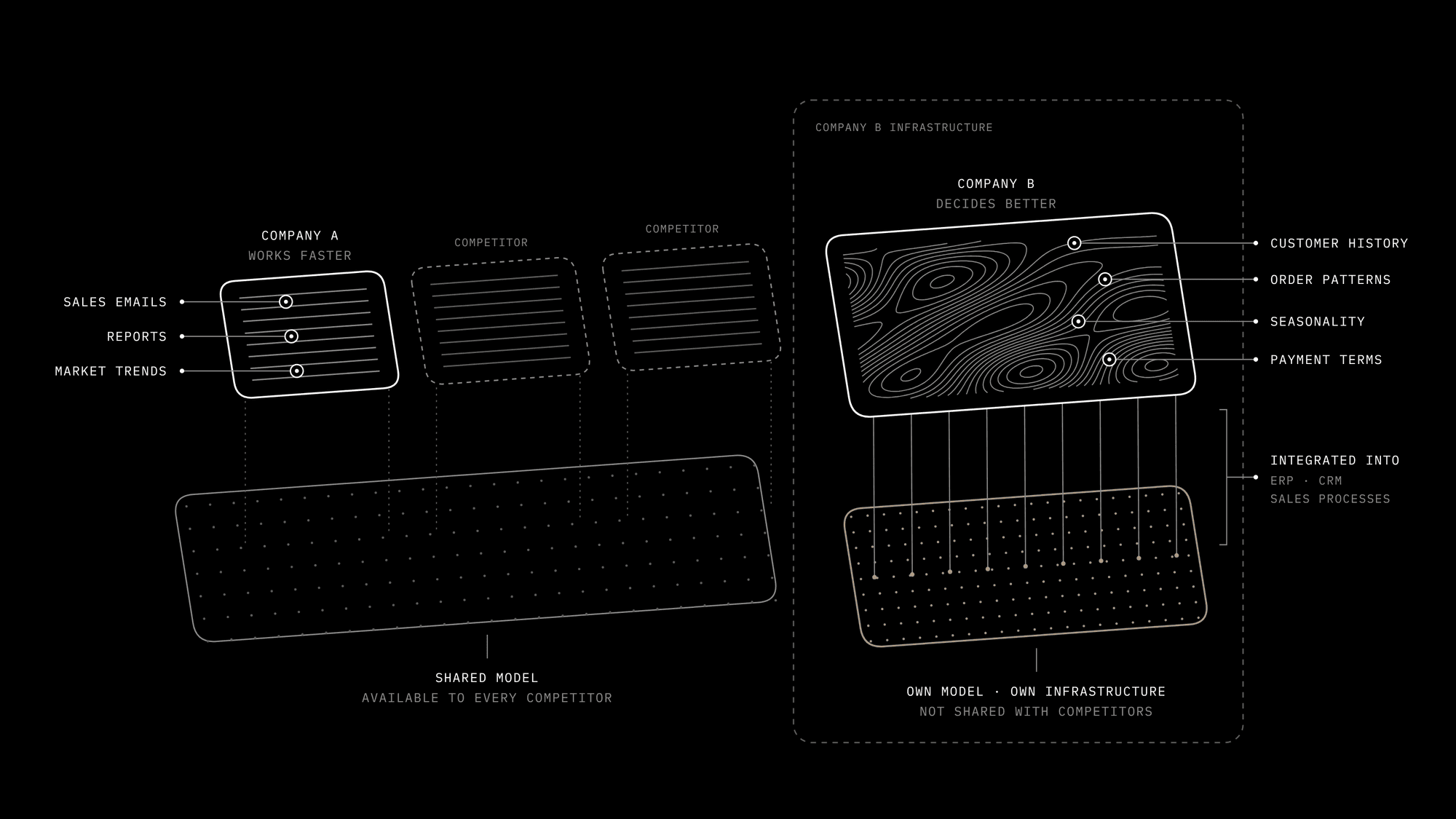
Imagine two distribution companies. The first uses generative AI to write sales emails, produce reports and analyse market trends. The second has developed its own AI system that continuously analyses years of customer history: ordering patterns, seasonality, profitability, payment terms and the behaviour of its sales teams. Such a system can recognise when a customer starts deviating from their usual behaviour, predict the risk of losing that customer and recommend a specific sales action before the problem becomes visible.

Who does the future belong to?
The first company uses AI to work faster. The second uses it to make decisions its competitors cannot make as well. The difference is not necessarily in the AI model itself. Both companies may use the same underlying technology. The difference lies in the data, the integrations, the business logic and the specific intelligence the second company has built around its own operations. That is where the potential for real competitive advantage is created.
I believe that in the coming years we will see an increasingly clear divide between two groups of companies. The first will use AI primarily as a tool. They will buy subscriptions, roll out off-the-shelf AI assistants and automate individual tasks. The second will start to treat it as strategic business infrastructure. They will systematically collect, structure and protect their own data. They will develop specific AI systems connected to their core business processes. They will build their own layers of business knowledge and intelligence that keep improving based on their organisation’s experience and results. This does not mean every company has to develop its own LLM or build its own data centres. On the contrary, in most cases such an approach would make no economic sense.
But it does mean that a company must keep control over what makes it different from its competitors: its data, its business logic, its specific knowledge, and the way that intelligence is used to create value. That is the key difference between simply using artificial intelligence and creating competitive advantage with it. Such an approach takes more time, greater investment, sound technology architecture and a deep understanding of your own business. Implementing it is more complex and demanding, but that is exactly where its greatest value lies. What is harder to build is also harder for competitors to copy. Competitive advantage has never come from doing what everyone else can easily do. It has always come from the ability to do what others cannot, or what they find extremely difficult to replicate.
In the age of artificial intelligence, the greatest competitive advantage will not belong to the companies using the most advanced AI models, which are available to everyone. It will belong to those that build their own unique, valuable systems on top of those models, systems their competitors cannot simply copy.