


Turn operational complexity into better decisions.
Every day, logistics teams coordinate people, jobs, vehicles, customers, schedules, documents and changing conditions.
Margins builds AI into those operations to help companies plan better, automate repetitive work, identify problems earlier and give teams the information they need to act.
See earlier. Decide faster. Operate better.
Logistics doesn’t run according to the plan.
- A customer changes a request.
- A job takes longer than expected.
- Someone calls in sick.
- A delivery arrives late.
- A vehicle becomes unavailable.
- An urgent job appears.
- A document is missing.
- Traffic changes.
- A customer doesn’t answer.
The challenge isn’t creating a plan. It’s continuously making good decisions as reality changes around it.
Give operations the ability to see, decide and respond.
Traditional operational software records what is happening. AI can add another layer.
See
Understand what is happening across jobs, people, customers, schedules and systems.
Predict
Identify what may happen next.
Prioritize
Determine what deserves attention.
Recommend
Suggest the best next action.
Act
Automate appropriate parts of the workflow.
Learn
Use what happened to improve future decisions.
AI becomes valuable when it changes the next operational decision — not when it creates another dashboard.
Every decision depends on something else.
A dispatcher isn’t simply assigning Job A to Person B. They may be balancing fifteen variables at once — including exceptions that aren’t written anywhere.
AI is useful when the number of variables exceeds what people can continuously optimize manually.
Put the right work with the right person at the right time.
AI-assisted scheduling can help operations teams evaluate more variables than a dispatcher can realistically compare manually. Depending on the business, that could include:
- Job priority
- Worker availability
- Skills
- Geography
- Estimated duration
- Customer windows
- Existing commitments
- Travel time
- Equipment
- Working-hour constraints
- Historical performance
- 01New job arrives
- 02Understand requirements
- 03Check people + schedule + location
- 04Evaluate options
- 05Recommend assignment
- 06Dispatcher approves
- 07Update operation
Let AI calculate the options. Let people manage the exceptions.
A good schedule at 8:00 AM can be a bad schedule at 11:00 AM.
When something changes, the impact can cascade. One delay affects another job, which affects another crew, which changes arrival times, which affects another customer. AI can help evaluate those dependencies and determine what should change.
Don’t just detect disruption. Understand what it changes.
- Technician unavailablealert
- Jobs affected6
- Alternative resources4
- Travel impactcalculated
- Customer commitmentschecked
- New planproposed
- Operationsapproves
Ask the operation a question.
Instead of searching across scheduling software, spreadsheets, email and messages, AI can bring relevant operational context together.
The best AI assistant isn’t the one that knows the most about the world. It’s the one that understands what’s happening in your operation right now.
- “Which jobs are at risk today?”
- “Who can take the urgent job in Split?”
- “Why is Crew 4 running behind?”
- “Which customers haven’t received an update?”
- “What jobs can we move without affecting tomorrow?”
- “Which technicians have the right certification?”
- “Show me today’s unresolved exceptions.”
Give field teams the information they need before they need to ask for it.
People in the field often depend on information scattered across:
The field shouldn’t have to call the office every time it needs context.
- ◎Customer history: 3 visits, last in March
- ⚠Previous problem: pressure drop on secondary line
- ⚙Equipment: boiler model BX-200
- ≡Required procedure: safety check 4.2
- →Bring: replacement valve kit
Let people report the work while they’re doing the work.
Field workers often have exactly the information the business needs — but capturing it creates administrative work. Instead of filling another form, they could just say it.
Turn what happened in the field into structured business data before the information disappears.
- Job statusCompleted
- Work performedMain valve replaced
- CustomerConfirmation captured
- Follow-upInspect secondary line in 3 months
- Inventory2 units consumed
- ReportStructured automatically
Your best operators shouldn’t spend their day moving information between systems.
- Job creation
- Dispatch updates
- Customer notifications
- Timesheets
- Photos
- Forms
- Delivery documentation
- Service reports
- Invoices
- Emails
- Data entry
- 01Field input
- 02Understand
- 03Extract
- 04Validate
- 05Update systems
- 06Notify
- 07Human exception when required
Automate the predictable. Escalate the exceptional.
Operations produce information machines weren’t designed to understand.
Information becomes more valuable when the operation can act on it automatically.
- 01Email arrives
- 02AI understands request
- 03Relevant information extracted
- 04Customer / job identified
- 05Operational system updated
- 06Task created
- 07Human reviews exception if required
The earlier operations knows something is going wrong, the more options it has.
Historical and real-time operational information can potentially reveal patterns around:
- Job overruns
- Repeated service issues
- Late deliveries
- Resource bottlenecks
- Customer risk
- Equipment problems
- Unusual operational behaviour
- Demand changes
- Capacity pressure
Prediction isn’t valuable because it tells you the future. It’s valuable because it gives you more time to change it.
A route is more than the shortest distance between stops.
In real operations, the best sequence may depend on many constraints. AI and optimization can help combine them into better field plans.
Optimize the operation, not just the kilometers.
AI needs the complete operational picture.
The information required for a good decision may live across ERP, CRM, scheduling, fleet systems, customer portals, accounting, inventory, workforce systems, document repositories and custom operational software. Margins connects those systems so AI can work with the right context.
AI transformation shouldn’t require replacing every system that already runs the operation.
Explore IntegrationsThe model is only one part of the operational system.
An intelligent logistics platform may need all of these. Margins engineers the complete system around the AI rather than stopping at the model.
- Mobile applications
- Dispatcher interfaces
- Customer portals
- Backend services
- APIs
- Real-time updates
- Maps
- Notifications
- Document processing
- AI models
- Data pipelines
- Integrations
- Infrastructure
- Monitoring
AI can provide the intelligence. Software makes it operational.
Our clients in logistics and field operations.
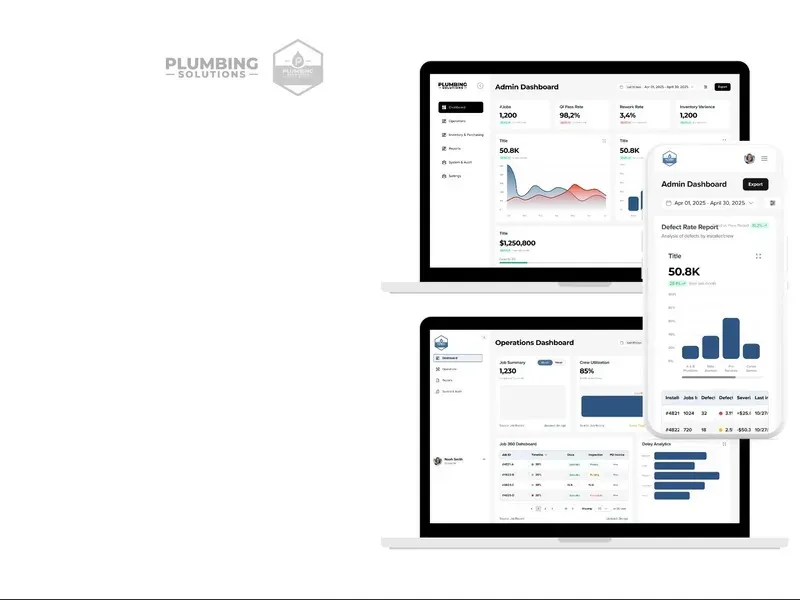
One operational layer connecting the office, the field and the systems behind them.
An operation handling 3,000+ projects a year, with operational losses estimated at $160K–$200K annually from fragmented tools. Margins brought together scheduling, dispatch, communications and integrations for 70+ bilingual installers.
- 3,000+ projects annually
- 70+ bilingual installers
- $160K–$200K annual losses addressed

AI applied to scheduling and logistics.
Work for AnTech / MARS around AI scheduling and logistics, focused on improving productivity, accuracy and scalability.
- AI scheduling
- Logistics
- Productivity · accuracy · scalability
The operation runs on knowledge that isn’t written down.
- Which jobs are likely to overrun.
- Which customer requires special handling.
- Which technician is best for an unusual problem.
- Which workaround actually works.
- Which issue deserves immediate escalation.
- What usually causes the problem.
- What to check first.
- Which exceptions matter.
The systems know what happened. Your people often know why.
Explore CaptaOperational intelligence can stay under your control.
AI for logistics may need access to sensitive information. Margins can design AI around customer-controlled infrastructure, private cloud and on-premise environments where appropriate.
Explore Private & On-Premise AI- Customer records
- Locations
- Routes
- Employee information
- Pricing
- Contracts
- Operational history
- Internal procedures
Bring AI to the operation without unnecessarily moving the operation somewhere else.
An operational blueprint, not an industry brochure.
Hover or tap any part of the operation to see the AI opportunities worth investigating there.
- Risk detection
- Operational forecasting
- Exception visibility
- Exception visibility
- Cross-operation decisions
- Notifications
- Service updates
- Request classification
- Demand forecasting
- Capacity planning
- Schedule optimization
- Dynamic assignment
- Exception handling
- AI copilot
- Job intelligence
- Knowledge assistant
- Voice reporting
- Proof of delivery
- Service reports
- Customer confirmation
- Route planning
- Priority optimization
- Dynamic replanning
- Skills matching
- Availability
- Workload balance
- Voice reporting
- Work orders
- Document processing
- Timesheets
- Data entry
- Billing preparation
- Reconciliation
Don’t automate the entire operation at once.
Find one valuable constraint. One useful AI implementation can become the foundation for the next.
- 01DispatchImprove assignment decisions.
- 02FieldGive teams better information.
- 03ReportingRemove manual administration.
- 04DocumentsAutomate repetitive processing.
- 05PredictionIdentify operational problems earlier.
- 06OrchestrationConnect decisions across the operation.
Go where the operational friction is.
We work with leadership and the people running the operation to understand:
- Where delays happen.
- Where schedules break.
- Where people spend time coordinating manually.
- Where information is repeatedly re-entered.
- Where decisions depend on one experienced person.
- Where customers wait unnecessarily.
- Where problems are discovered too late.
- Where systems don’t communicate.
- Where administrative work consumes operational capacity.
- 01Process
- 02Friction
- 03Data
- 04AI opportunity
- 05Value × Feasibility
- 06First implementation
The objective isn’t to automate everything. It’s to find the constraint worth removing first.
We engineer around the operation, not around the AI.
Business first
Start with the operational constraint rather than the technology.
AI + software
Build both the intelligence and the applications required to use it.
Enterprise integration
Connect existing operational systems instead of assuming a greenfield environment.
Mobile & field
Bring technology to the people doing the work.
Private architecture
Design around the customer’s infrastructure and data requirements.
Production ownership
Forward Deployed Engineering and Managed AI keep the system close to operational reality after deployment.
Related capabilities
AI Strategy & Consulting
Find where AI can create measurable operational value.
Explore AI Strategy →AI Engineering
Build production AI around operational workflows.
Explore AI Engineering →Software Engineering
Build the applications and platforms around the intelligence.
Explore Software Engineering →Integrations
Connect AI to scheduling, ERP, CRM and operational systems.
Explore Integrations →Forward Deployed Engineering
Put engineers close to the operation as the system meets reality.
Explore FDE →
Where is complexity costing your operation the most?
We’ll work with your leadership and operational teams to understand where decisions, coordination or repetitive work are creating unnecessary cost — and determine where AI can make the biggest measurable difference.
Explore AI opportunitiesStart with the operation. Find the constraint. Build from there.